Understanding germination niches to guide climate-resilient restoration
New insights into germination niches presented at the International Society for Seed Science Conference.
Large-scale restoration is planned across Western Sydney, but many species’ germination requirements under future climate conditions remain poorly understood. PhD candidate Chaminda Alahakoon presented new research at the International Society for Seed Science Conference (ISSS 2025) in Perth, highlighting how temperature and water stress shape the germination niche of native species in the Cumberland Plain.
Chaminda’s study examined 28 species across a wide range of functional types, climate origins and vegetation communities. Seeds were germinated under six temperature treatments and seven water-stress levels to model species’ thermal and moisture thresholds. The results revealed striking species-specific germination niches, with optimal temperatures ranging from 14–27 °C and base water potentials varying from –0.1 to –1.5 MPa.
By combining these germination parameters with current and future climate projections, Chaminda modelled how germination windows may shift across the region. The findings suggest that climate change may alter species establishment patterns, potentially reshaping plant community composition on the Cumberland Plain.
This work provides a crucial evidence base for species selection, seed-treatment methods and optimal sowing times, helping restoration practitioners design climate-resilient ecosystems. The project also involved collaboration with researchers at Kings Park, Western Australia, where Chaminda gained experience with seed testing, storage techniques and restoration field sites.
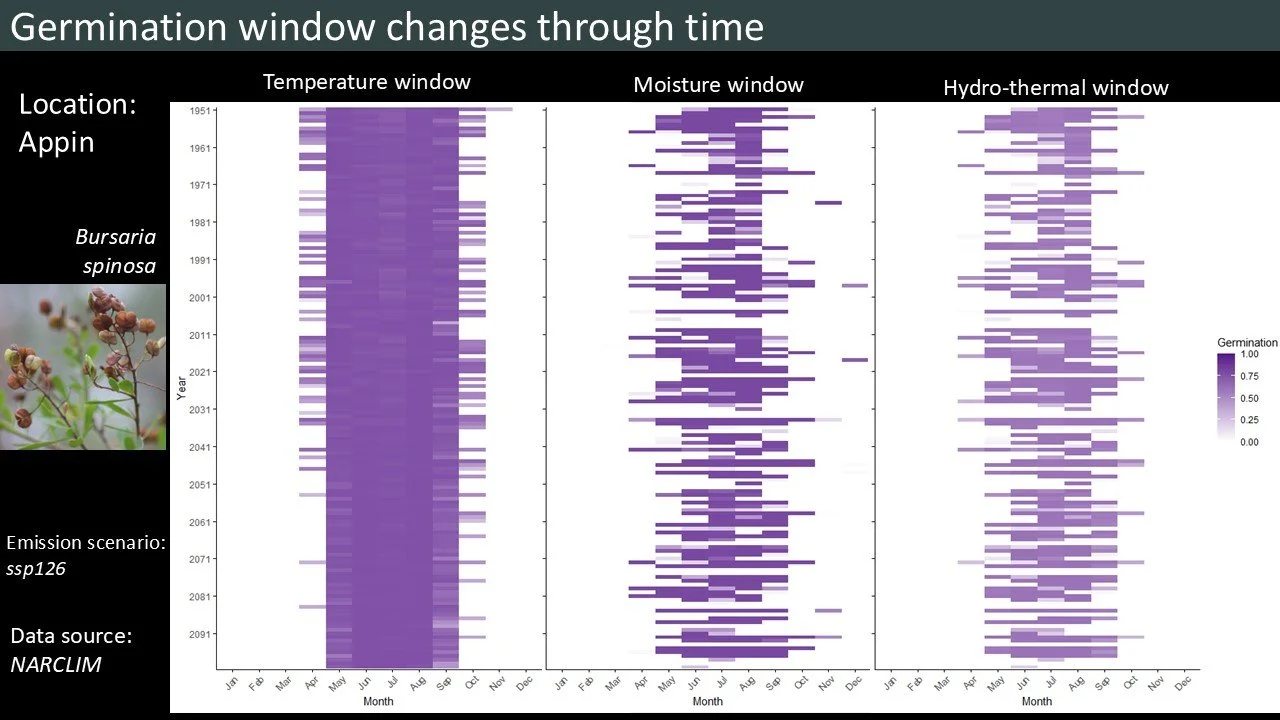
Slide of Chaminda’s presentation at the ISSS 2025 in Perth.