How microhabitat conditions shape seedling emergence in the Cumberland Plain Woodland
Understanding the microhabitat factors that help native seedlings establish in grassy woodlands.
Seedling emergence and survival are strongly shaped by fine-scale environmental conditions - a factor that becomes increasingly important as climate change alters rainfall and temperature patterns. At the Australasian Seed Science Conference (ASSC 2025) in Horsham, PhD candidate Chaminda Alahakoon presented new research exploring how shade, leaf litter and local climate influence seedling establishment in grassy woodlands.
The study focused on eight native species with contrasting germination niches and was carried out at two remnant Cumberland Plain woodland sites differing in climate. Each site included open and closed canopy conditions, with leaf litter manipulated to mimic natural variation. Soil temperature, moisture and rainfall were monitored throughout the experiment.
Chaminda found that canopy cover, litter presence and locality all played significant roles in emergence patterns. Overall, seedling emergence was highest under closed canopy with leaf litter, particularly at the cooler, wetter locality. Summer rainfall triggered emergence in a few species, but total emergence remained low for most (<20%), with Microlaena stipoides as a notable exception (>75%). Mortality was high across all treatments, often linked to hot, dry conditions.
These findings help refine predictions of recruitment success under future climate scenarios and will support more accurate modelling of woodland resilience. They also contribute directly to restoration planning aimed at strengthening ecosystem function on the Cumberland Plain.
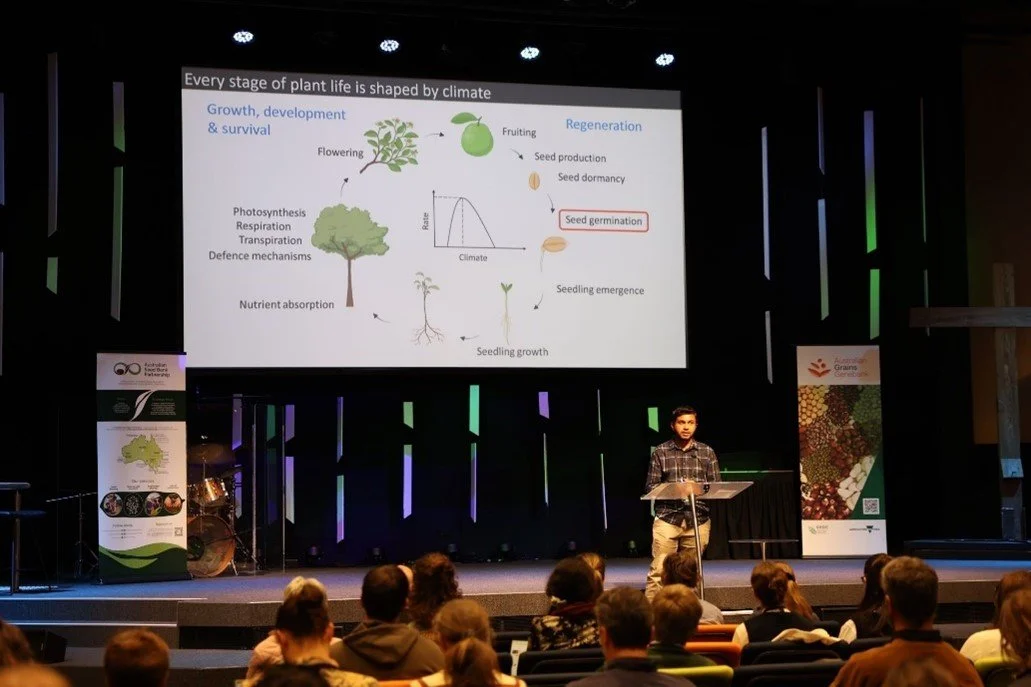
Chaminda presenting at the ASSC 2025 in Horsham, Victoria. Photo credit: Brad Desmond.