Why size matters: The importance of large trees for wildlife in the Cumberland Plain
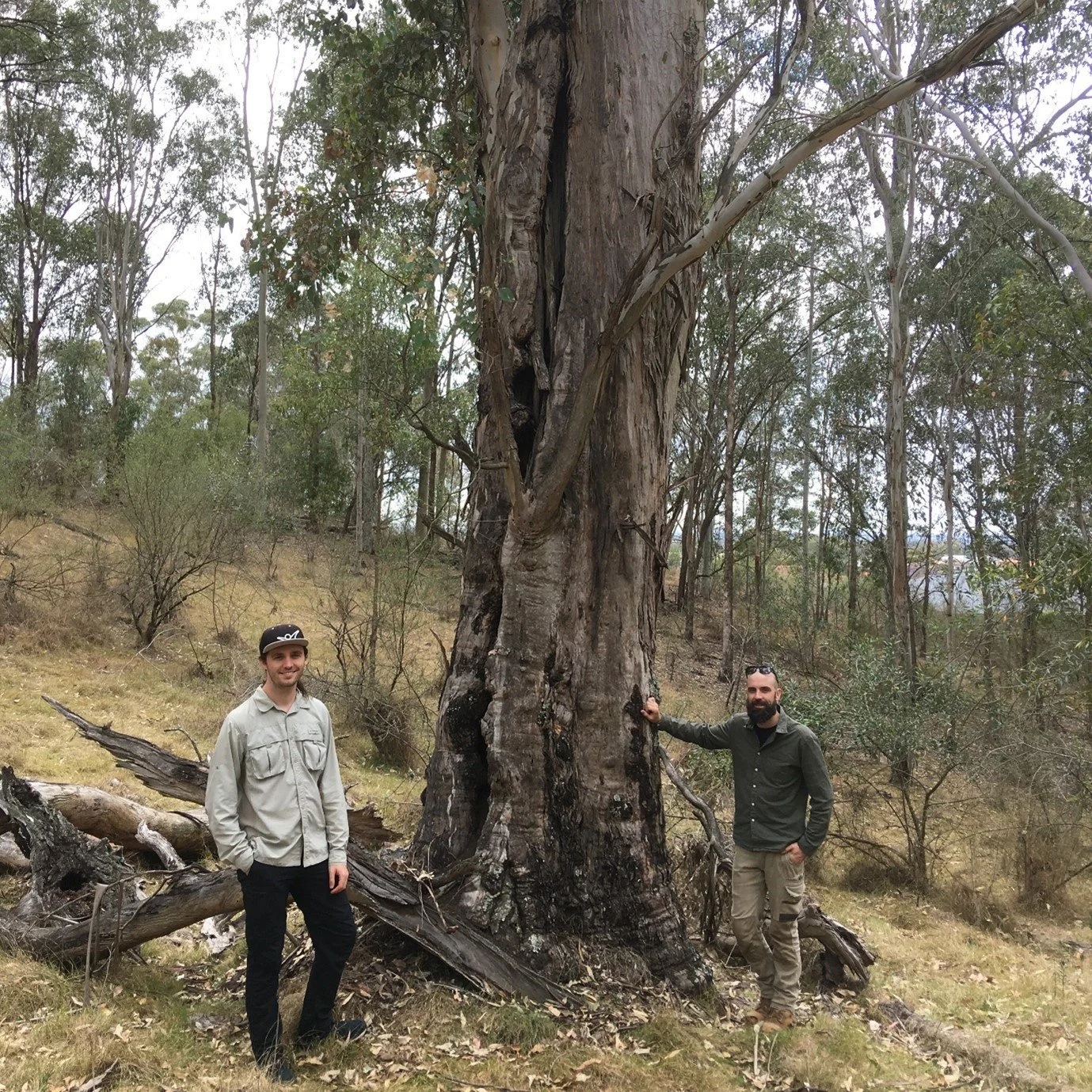
PhD student Dylan Bristol (left) and Research Assistant Jeremy Bendall (right) next to a large hollow-bearing eucalyptus tree during fieldwork. (Image: Michael Franklin)
A new study led by Dr Michael Franklin has assessed the availability of tree hollows in Cumberland Plain Woodland. Published in Pacific Conservation Biology, the research examined 100 woodland plots across Western Sydney, investigating how tree size influences the availability of this critical habitat resource.
Researchers recorded 5,566 living trees, but found that only 3.1 trees per hectare contained large hollows (openings greater than 10 cm).
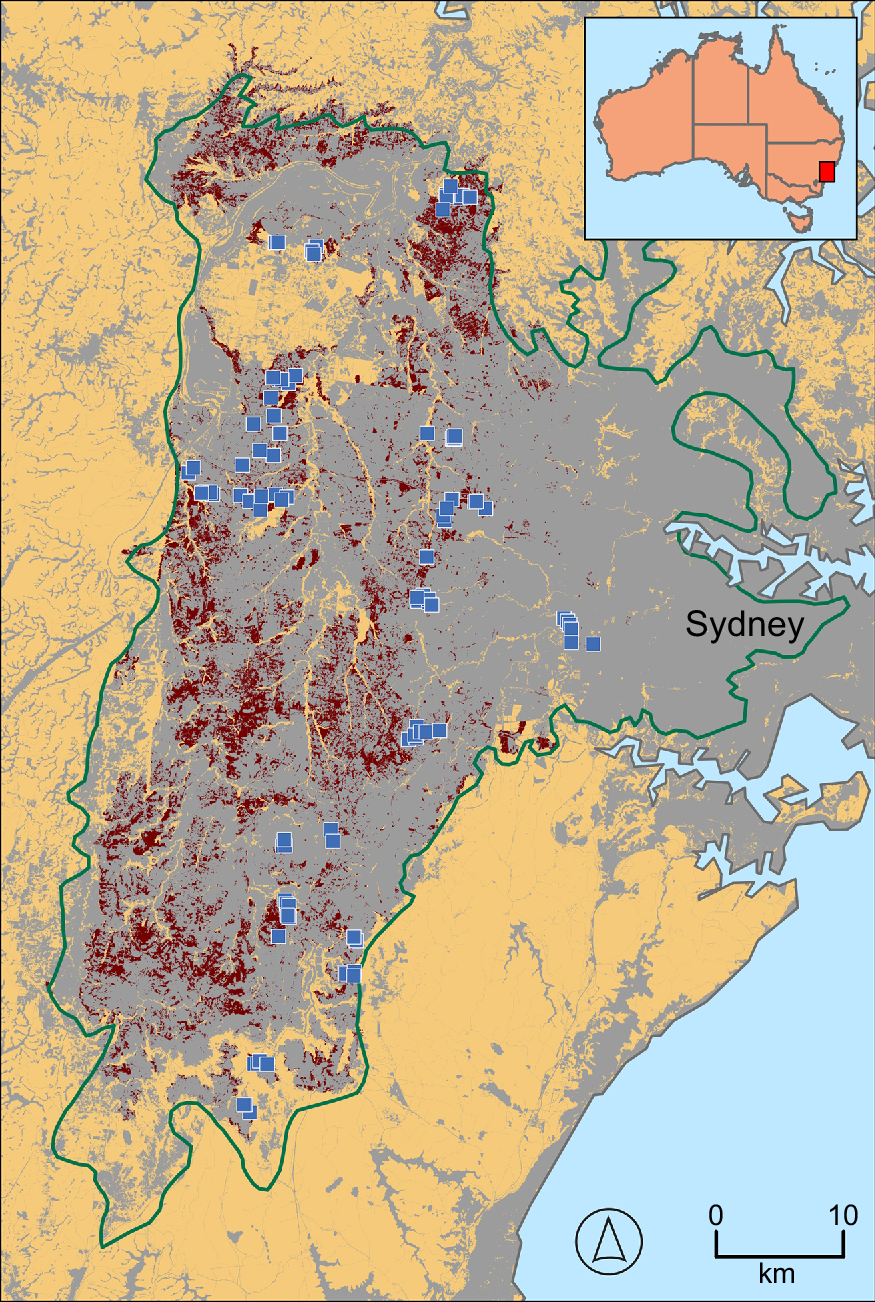
Fig: Field sampling of native tree diameters and hollows was conducted in 100 plots (blue squares) situated across the extant distribution of Cumberland Plain Woodland (dark red regions). Other native vegetation communities are shown in light orange, with grey shading indicating anthropogenic land uses. The boundary of the Cumberland Interim Biogeographic Regionalisation of Australia (IBRA) Subregion is coloured green. (Image: Michael Franklin)
Highlights from the findings
Large hollows are in short supply: Researchers recorded an average of 15.6 hollow-bearing trees per hectare, but only 3.1 trees per hectare contained large hollows (openings greater than 10 cm). Previous studies of less-disturbed eucalypt woodlands and open forests have reported higher overall densities of hollow-bearing trees, although availability varies between ecosystems.
Tree size matters: Hollows were unlikely to occur in living trees with trunk diameters below 50 cm. Yet almost 90% of the living trees surveyed were smaller than 30 cm in diameter.
Threatened wildlife may be affected: The low availability of large hollows may have implications for threatened species including the Powerful Owl, Glossy Black-Cockatoo, Gang-gang Cockatoo and Yellow-bellied Glider, which depend on suitable hollows.
Why this research matters
Cumberland Plain Woodland has undergone extensive clearing and modification, leaving many remaining woodland patches dominated by relatively small trees.
While these trees contribute to woodland regeneration, they often lack the hollows needed by native wildlife. Large hollows develop over long periods, meaning that restoring tree cover alone will not immediately replace these critical habitat resources.
Restoring suitable habitat for hollow-dependent wildlife requires both immediate action and long-term planning. Large tree hollows can take many decades to develop, meaning that newly established woodland may not provide suitable nesting and shelter resources for many years.
The study identifies three complementary priorities for conservation and restoration:
Protect existing hollow-bearing trees: Identify and retain mature trees that already provide valuable habitat.
Grow the next generation of large trees: Manage woodland structure to support the development of larger trees and future hollows.
Provide artificial hollows where needed: Trial and monitor suitable artificial hollows to provide habitat for target species while natural hollows develop.
Together, these approaches highlight the importance of planning beyond immediate revegetation outcomes. Restoring woodland habitat is not simply about increasing tree cover, but also ensuring that future generations of trees can provide the structures that native wildlife depends on.
By identifying current habitat shortages and potential management responses, the research provides practical evidence to support long-term conservation planning for hollow-dependent wildlife.
Read the full paper in Pacific Conservation Biology.
Learn more about the Assessment of Contemporary Tree Hollow Resources project.
Few large tree hollows in an endangered peri-urban ecosystem highlights the need to restore suitable habitat for dependent woodland fauna, Franklin, M. J. M., Gordon, C. E., Gorrod, E. J., Emlaei, Z., Bendall, J., Bristol, D., Rymer, P. D. and Nielsen, U. N. (2026). Few large tree hollows in an endangered peri-urban ecosystem highlights the need to restore suitable habitat for dependent woodland fauna. Pacific Conservation Biology, 32, PC26055. https://doi.org/10.1071/PC26055