What does patterns of enrolment in formal private land conservation in NSW teach us and how can we improve uptake?
Much of nature and biodiversity in New South Wales occurs on privately owned and managed lands. In Western Sydney and the Cumberland Plain, where urbanisation and population growth are accelerating, development pressure on ecosystems is expected to continue for at least the next couple of decades. This means that human-related threats to biodiversity on private lands will intensify. It also means that the land use decisions of private landholders will progressively play a critical role in determining the prospect of conservation outcomes and human connection to nature across this landscape.
Most undeveloped private lands generally receive some sort of conservation management. However, it is difficult to assess and monitor changes in their number, coverage area, and ecological condition if those lands are not enrolled in formal private land conservation programs. Formal private land conservation programs provide a structure for supporting landholders interested in nature protection with technical assistance, grants, and access to peer networks.
Enrolment in private land conservation programs requires landholders to enter into a contractual agreement with a government agency or land trust. The agreement prescribes practices that the landholder is obligated to maintain and stipulates activities they must refrain from in the interest of biodiversity values on their properties. The design of these agreements varies. The agreements may be fixed-term or permanent, eligible for financial incentives or not. Depending on the limits that the text of the agreement imposes on the landholders and the benefits it offers, conservation may attract landholders to enrol or dissuade them from enrolling.
In essence, landholders’ enrolment decision is, in fact, choosing a type of conservation agreement. Assessing trends in landholders’ uptake of the conservation agreements can offer insights into how to improve landholder enrolment, conservation program governance, and ecological outcomes.
Recent research from the Cumberland Plain Research Program is shedding light on how selective preference for conservation agreements influences ecological outcomes.
Understanding landholders’ self-selection into conservation agreements: what the research shows
PhD candidate Emmanuel Ugwu is examining how landholders’ enrolment decisions structure spatial and temporal patterns across New South Wales. He analysed the dataset of active enrolments in NSW government-administered private land conservation programs from 1960 to December 2025.
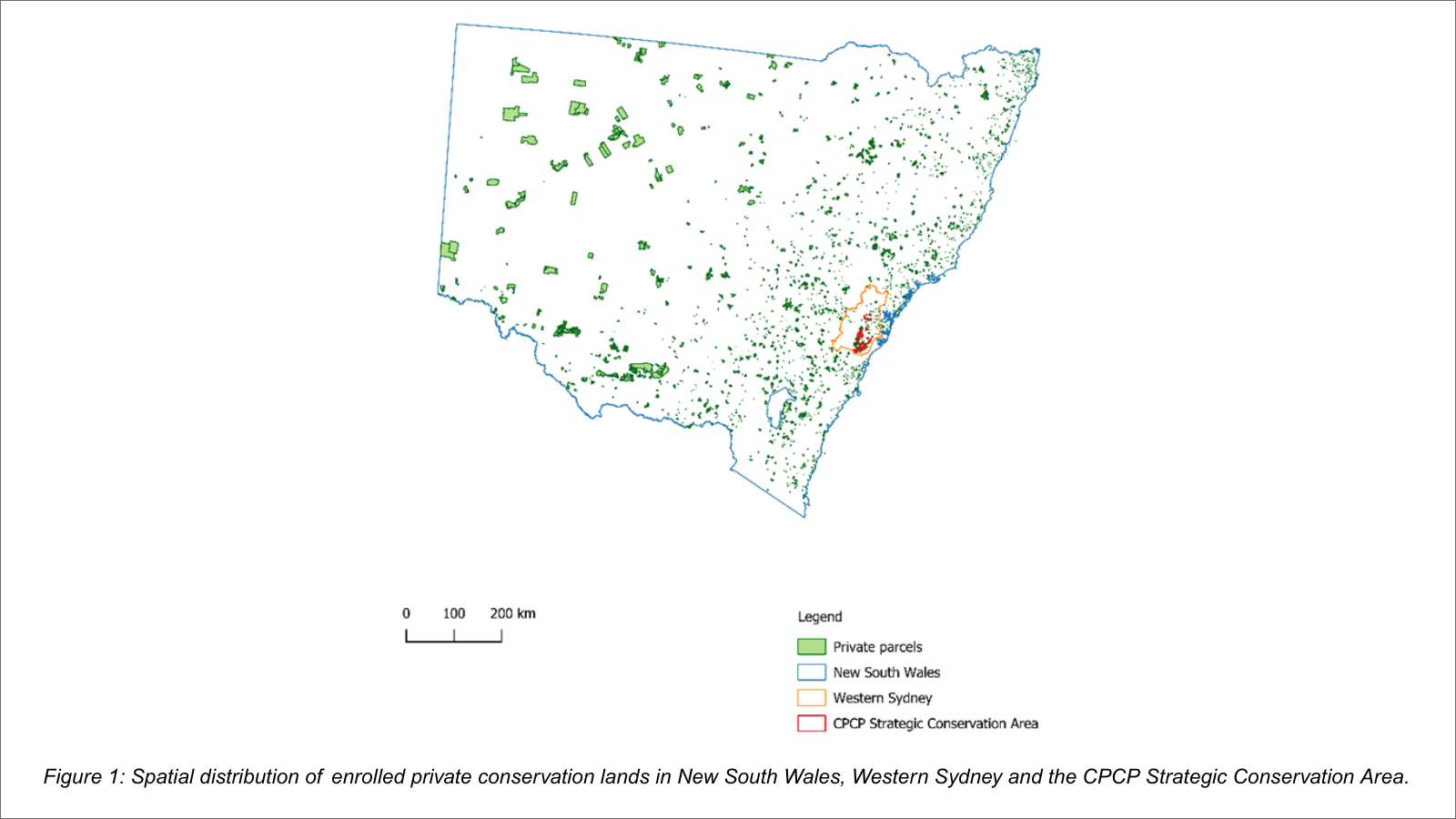
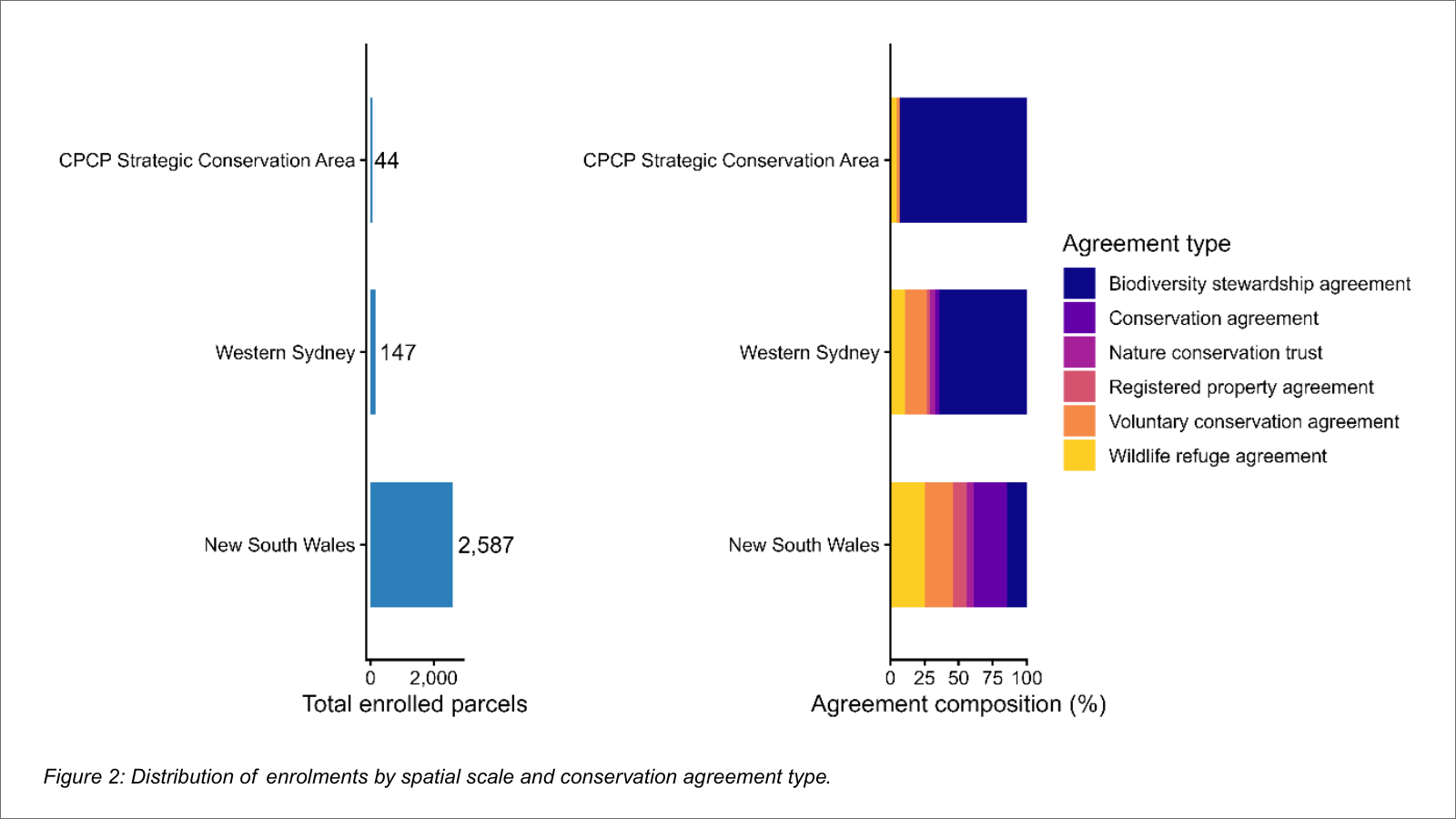
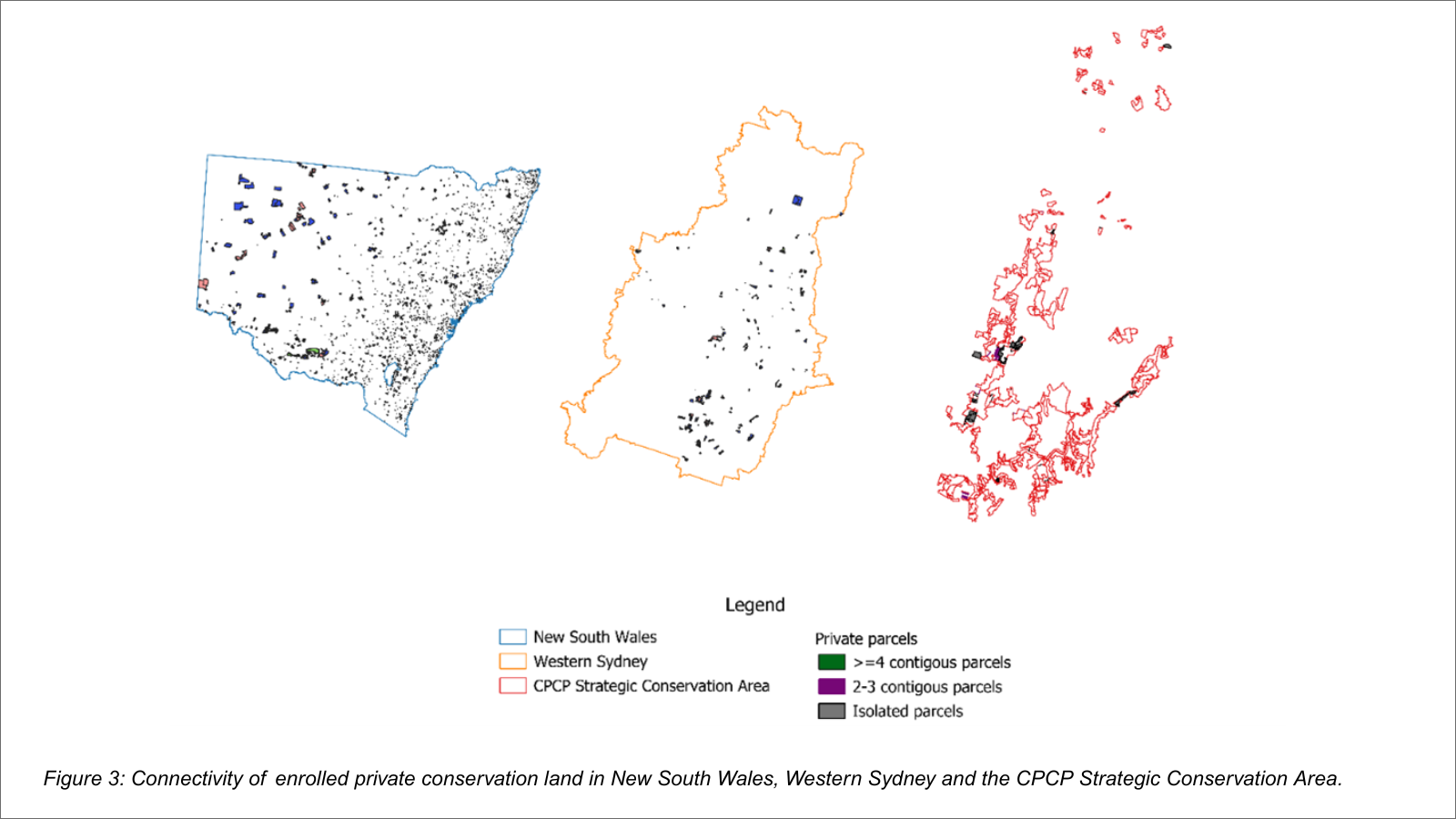
His research highlights several key insights:
Flexibility is magnetic
Across NSW, conservation agreements with the lowest barriers to entry and exit, Wildlife Refuge Agreements, attracted the highest number of enrolments.
Wildlife Refuge Agreements also accounted for the largest enrolled parcels in NSW and Western Sydney.
Wildlife Refuge Agreements created the most populous clusters of connected parcels, having the greatest number of >=4 adjacent parcels.
Enrolments in Western Sydney lag behind the rest of NSW
Median enrolments per year across NSW have generally increased since the 2000s, following decades of poor growth between 1960s and 1990s.
Conversely, the median enrolments in Western Sydney and the area now known as the Cumberland Plain Conservation Plan Strategic Conservation Area (CPCP SCA), have remained largely stagnant since the 1960s, with an uptick in the 2000s and a slight dip in the 2010s.
Permanence of conservation enrolments
About 96.5% of enrolled parcels in NSW are protected permanently, while 3.5% are term agreements.
The median duration of the term agreements is 20 years while the minimum duration is 15 years.
While conservation agreements with lowest barriers to entry and exit allows landholders to quit at will, landholders enrolled their parcels for a minimum duration of 15 years.
These findings suggest that there are opportunities to improve enrolment diffusion, extent of conserved area and landscape connectivity through social marketing of private land conservation programs and improved design of conservation agreement attributes.
From insight to application
This research has important implications for conservation planning and program delivery across the Cumberland Plain.
It highlights the imperative:
Incorporate flexible eligibility criteria and enrolment terms into program to accommodate to land use priorities of diverse landholders
Practice proactive and ongoing landholder engagement and outreach
Strengthen partnership with landholder groups through local networks and peer learning
Importantly, the research also highlights that easy-to-opt-in and-out conservation agreements can play a valuable role in growing landholder enrolment and contribution toward longer-term conservation outcomes.
Supporting better decisions through data and partnerships
This work is further strengthened through collaboration with government partners.
A data sharing agreement with between CPR and DCEEW will enable us access datasets on community appreciation of biodiversity, allowing us to examine changes and continuities in people’s attitudes and behaviour toward biodiversity.
Together, these partnerships support a more integrated approach to conservation planning: connecting research, policy, and on-ground implementation.
Looking ahead
As the Cumberland Plain Research Program continues to move into a translation and application phase, understanding the human connection to nature will remain a key priority.
By combining ecological research with insights into behaviour, participation, and decision-making, the program aims to support more effective, inclusive, and scalable conservation outcomes across Western Sydney.
We welcome feedback from practitioners, policymakers and landholders. What approaches have you seen work well in increasing participation in conservation programs?