From soil to canopy: rethinking how we monitor woodland recovery
Restoring Cumberland Plain woodland is not simply a matter of planting trees or increasing vegetation cover. True recovery involves rebuilding ecological processes - from the soil beneath our feet to the canopy above - and understanding how those layers interact over time.
But how do we measure whether restoration is genuinely working?
Traditional monitoring often relies on a limited set of indicators, such as plant survival rates or short-term vegetation change. While useful, these metrics can miss deeper ecological dynamics that determine long-term resilience. Across the Cumberland Plain Research Program, researchers are working to rethink monitoring frameworks by building an integrated evidence base that connects vegetation structure and composition, soil biology and function, and biodiversity outcomes.
This multi-layered approach is helping strengthen restoration practice and decision-making across the region.
Why monitoring needs to be multi-layered
Ecosystems operate as interconnected systems. For example, soil physical, chemical and biological properties influence plant establishment and vegetation dynamics. Conversely, canopy structure shapes microclimate and understorey diversity, with cascading effects belowground. Further, landscape context moderate dispersal patterns and population dynamics, which has implications for how wildlife responds to restoration efforts.
When monitoring focuses on only one component, it can provide an incomplete picture. A site may show increased vegetation cover while soil function remains compromised. Structural simplification may limit habitat value even where species richness appears stable. Without integrated monitoring, it is difficult to interpret change, adjust management or compare outcomes across sites.
Recognising this complexity, researchers within the program are generating complementary datasets that collectively strengthen how restoration progress can be evaluated.
The soil layer: understanding the foundations of recovery
Healthy soils underpin ecosystem resilience. Soil biodiversity, nutrient cycling and microbial communities all influence plant growth, drought tolerance and recovery from disturbance.
Research led by PhD candidate Dylan Bristol examines how soil biodiversity, chemical pollutants and vegetation degradation interact to influence ecosystem function across the Cumberland Plain Woodland. By analysing soil physical, chemical and biological attributes across sites spanning a range of condition states, this work is establishing a baseline understanding of soil function in the region.
These datasets help answer critical questions for restoration:
How does soil condition vary across degraded and intact sites?
Which soil indicators are most closely linked to ecosystem functioning?
How might belowground processes constrain or support aboveground recovery?
By strengthening knowledge of soil processes, the program contributes to more informed interpretation of restoration outcomes and more realistic expectations of recovery trajectories.
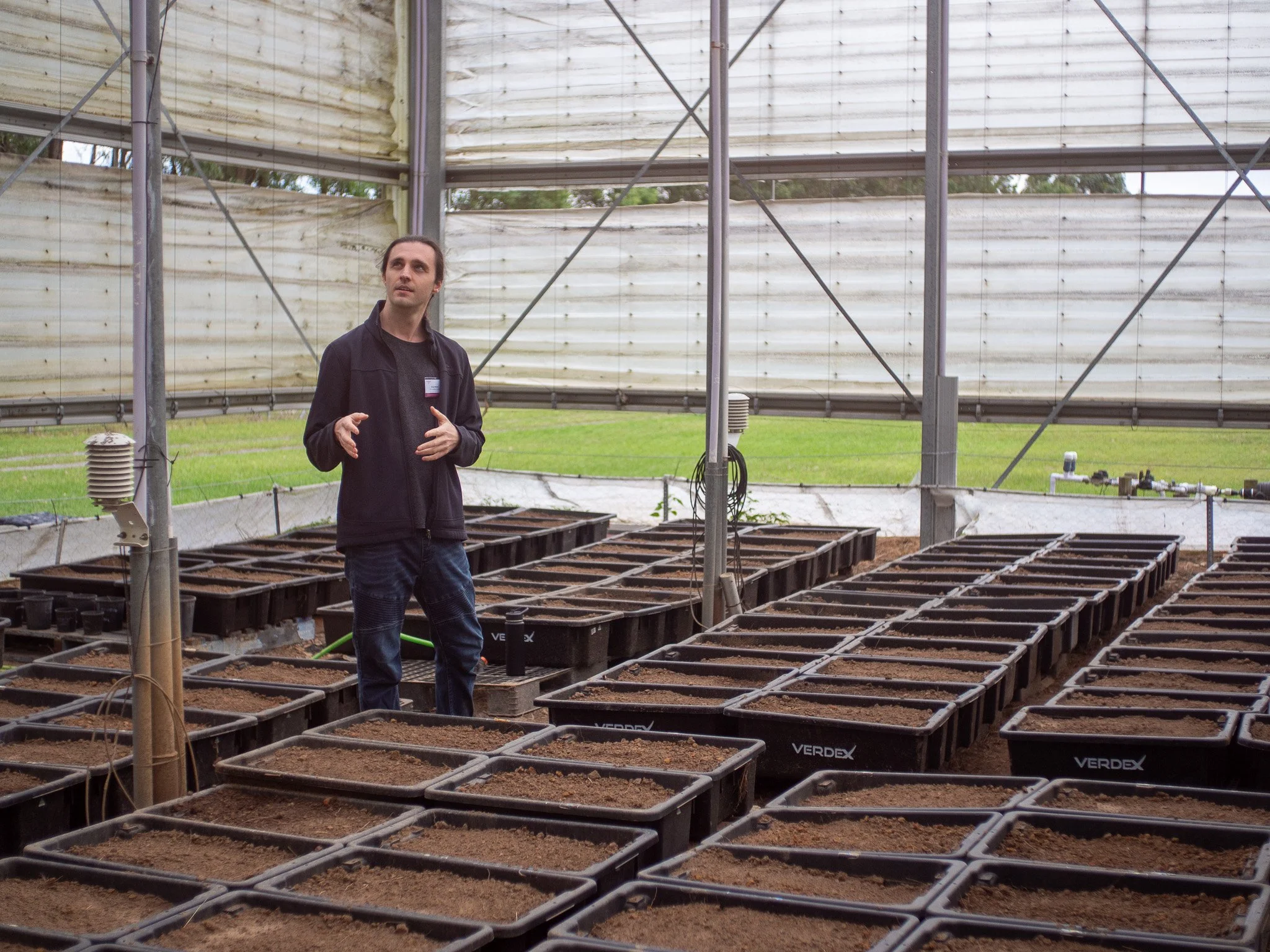
Dylan Bristol presenting his soil biodiversity experiment at HIE’s rainout shelter facility. (Image: Caitlin Dagg)
Vegetation structure: linking habitat complexity to biodiversity
Woodland structure, including canopy height, density and vertical complexity, plays a central role in shaping biodiversity. Structural simplification is common in fragmented and peri-urban landscapes and can reduce habitat quality even where vegetation remains present.
Research led by PhD candidate Caitlin Dagg integrates airborne LiDAR-derived vegetation structure metrics with extensive plant and bird datasets across the Cumberland Plain. This work demonstrates strong associations between structural complexity and species richness, and shows that landscape context, including fragmentation and urbanisation, influences how biodiversity responds to structural change.
From a monitoring perspective, structural metrics offer significant advantages:
They can be measured consistently across large landscapes.
They provide early signals of habitat change.
They support site prioritisation and conservation assessment.
By linking structural complexity to biodiversity outcomes, this research strengthens the evidence base for managing woodland condition at both site and landscape scales.
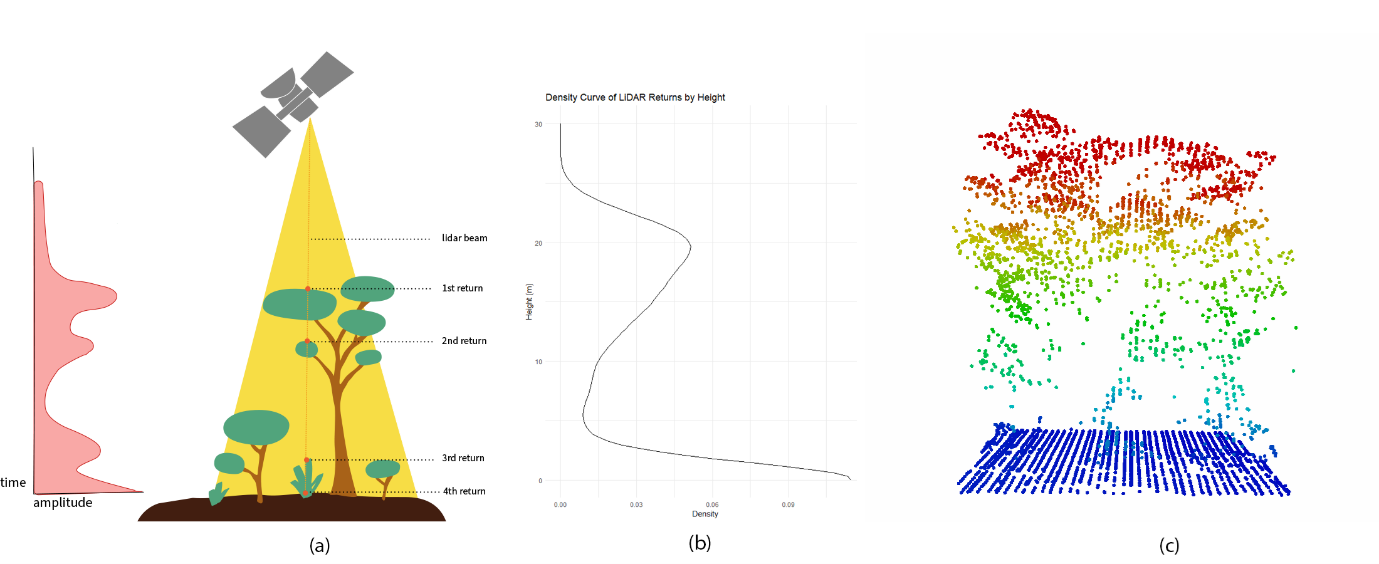
(a) Illustration of LiDAR collection; (b) Density curve of LiDAR returns by height for a 20x20m floral survey plot; (c) Point cloud of LiDAR returns for the same plot (Image: Caitlin Dagg)
Canopy diversity and understorey outcomes: informing management practice
Restoration outcomes are shaped not only by the presence of trees, but by the diversity and composition of canopy assemblages.
In the study “Structurally diverse and species-rich canopy tree assemblages support native herbs in grassy woodlands” (Franklin et al., 2025, Biological Conservation), researchers demonstrate that diverse and structurally complex canopies enhances native herb communities.
A complementary synthesis, “State of knowledge on the effectiveness of management interventions to restore degraded eucalypt woodlands” (Restoration Ecology), evaluates current evidence on restoration interventions and highlights where management actions are most likely to deliver biodiversity gains.
Together, this research strengthens understanding of how canopy characteristics influence understorey recovery and helps identify management approaches that are both ecologically effective and cost-efficient.
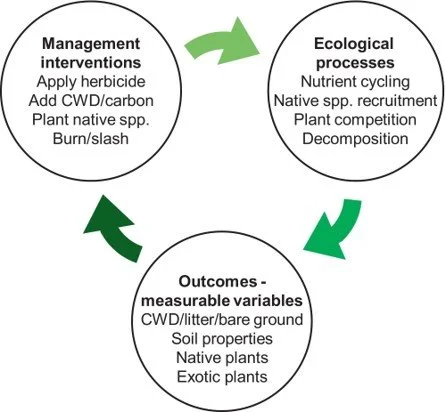
Conceptual framework for gaining and applying knowledge about the effectiveness of restoration interventions. Management interventions alter ecological processes to create measurable outcomes, which can be captured and evaluated to inform the next iteration of actions or intervention selection for new projects. The examples provided are a subset of possibilities and are not exhaustive. (Image: Michael Franklin)
From research to practical monitoring frameworks
Individually, monitoring and assessments of soil attributes, understory vegetation, and canopy structure and composition provide valuable insights. Collectively, they support a more comprehensive monitoring framework for woodland recovery.
An integrated approach allows practitioners and decision-makers to:
Interpret restoration outcomes across ecosystem layers
Identify early warning signs of declining condition
Compare site trajectories more reliably
Prioritise interventions based on evidence
Strengthen reporting and accountability
As the program progresses, there is increasing emphasis on synthesising datasets and translating findings into accessible outputs that support conservation planning and restoration delivery under the Cumberland Plain Conservation Plan.
Supporting long-term resilience
Woodland recovery is not a short-term process. Monitoring frameworks must capture change across time and across scales, accounting for soil dynamics, vegetation structure and landscape pressures.
By building connected datasets and strengthening cross-project integration, the Cumberland Plain Research Program is contributing to a more robust understanding of ecosystem resilience in Western Sydney.
From soil to canopy, rethinking how we measure recovery helps ensure restoration efforts are grounded in evidence and capable of delivering lasting ecological outcomes.
Structurally diverse canopy tree assemblages support native herbs in grassy woodlands
Franklin, M.J.M., Ridgeway, P., Bristol, D., Bendall, J., Rymer, P.D. and Nielsen, U.N., (2026), Structurally diverse and species rich canopy tree assemblages support native herbs in grassy woodlands. Biological Conservation, Volume 313, 2026, 111526, ISSN 0006-3207. https://doi.org/10.1016/j.biocon.2025.111526.
State of knowledge on the effectiveness of management interventions to restore degraded eucalypt woodlands
Franklin, M.J.M., Gorrod, E.J., White, L.A., Oliver, I., Rymer, P.D. and Nielsen, U.N. (2025), State of knowledge on the effectiveness of management interventions to restore degraded eucalypt woodlands. Restor Ecol, 33: e70004. https://doi.org/10.1111/rec.70004.